
DMR Two-Way Radios: Guide to Portables, Mobiles, and Repeaters
, by Joseph Gabriel, 9 min reading time
, by Joseph Gabriel, 9 min reading time
Transitioning your commercial operations to a Digital Mobile Radio system improves voice clarity, expands coverage, and unlocks advanced data capabilities. Although the DMR acronym includes the word mobile, Digital Mobile Radio is an open technical standard designed for an entire radio ecosystem that includes handheld portable radios, vehicle-mounted mobile transceivers, and fixed infrastructure repeaters. Evaluating how manufacturers like Motorola Solutions and Hytera build equipment across these three hardware tiers allows project managers to deploy a fully integrated communication network.
To design an effective communications system, equipment buyers should understand how the three primary DMR hardware components interact across a commercial facility or coverage territory.
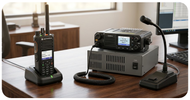
Portable two-way radios are compact, battery-powered units carried on an operator's belt or shoulder harness. Operating at lower power levels (typically 1 to 5 watts), portables provide instant voice communication for security personnel, warehouse staff, and field technicians moving on foot. Modern DMR portables feature durable IP-rated housings, long battery life, and compact displays for selecting talk groups. Explore our complete selection of Motorola portable radios and Hytera portable radios to match your fleet needs.
Mobile radios are high-power transceivers (typically 25 to 50 watts) installed directly into commercial vehicles or mounted on a desktop with an AC-to-DC power supply. Powered by the vehicle's electrical system or wall current, mobiles connect to external exterior antennas to deliver superior range. They serve as the backbone for vehicle drivers, equipment operators, and central dispatch offices.
Repeaters are fixed infrastructure units installed at high locations, such as equipment towers, rooftop masts, or central utility closets. A DMR repeater receives weak signals from portable or mobile radios, cleans up the digital data stream, and retransmits the signal at high power (often 25 to 100 watts). Repeaters double channel efficiency using TDMA technology while bridging coverage gaps across large physical plants or regional service territories.
When ordering commercial DMR equipment, the packaging typically includes basic operational hardware, but complete system deployment requires selecting complementary accessories based on your environment.
Components usually included with DMR hardware:
Essential accessories buyers must select separately:
For detailed recommendations on outfitting your mobile installations, review our guide covering mobile radio essential accessories.
Digital Mobile Radio is an international open digital radio standard specified by the European Telecommunications Standards Institute to replace legacy analog systems across commercial and industrial enterprises. The standard is divided into three distinct tiers. Tier I covers low-power, license-free consumer applications in Europe. Tier II covers conventional licensed commercial systems utilizing direct mode and repeaters. Tier III covers complex trunked radio networks utilizing dynamic channel allocation for large enterprises.
The key technical innovation of DMR is Time Division Multiple Access technology. TDMA divides a standard 12.5 kHz radio channel into two alternating time slots. By transmitting data in rapid, alternating pulses, a single DMR repeater or frequency channel supports two separate conversations simultaneously. This doubles system capacity without requiring additional frequency licenses from regulatory bodies.
Furthermore, digital vocoders inside portables, mobiles, and repeaters process incoming speech to filter out background noise like diesel clatter, wind, and industrial machinery. Instead of transmitting fading analog waves that turn to static over distance, the system transmits encoded data packets that reconstruct clean voice audio right up to the edge of the coverage boundary.

A common point of confusion is the difference between DMR and Motorola MOTOTRBO. DMR is the underlying open technical standard, whereas MOTOTRBO is Motorola Solutions' brand portfolio built upon the DMR framework. The MOTOTRBO line includes portable radios, mobile transceivers, and system repeaters engineered for commercial and industrial users.
Because Motorola designs MOTOTRBO equipment to comply with standard DMR Tier II specifications, MOTOTRBO portables and mobiles can communicate with standard DMR radios and repeaters from other manufacturers on conventional unencrypted channels. However, Motorola also offers proprietary features designed to enhance system performance. Advanced software capabilities like Capacity Plus trunking, IP Site Connect for multi-site networking, and specialized encryption options operate exclusively within the MOTOTRBO environment.
Hytera manufactures a complete suite of DMR hardware—including handheld portables, mobile transceivers, and high-performance repeaters—built strictly around the ETSI DMR standard. Hytera equipment is widely recognized for rugged industrial construction, clear color displays, and efficient spectrum management.
Because Hytera adheres to the open DMR standard, their Tier II portables and mobiles integrate smoothly into existing conventional DMR repeater networks. Like Motorola, Hytera has also developed proprietary software enhancements for enterprise customers, such as Extended Pseudo Trunking (XPT). Integrating Hytera hardware into an existing conventional network provides project managers with a reliable, feature-rich equipment option.

Deploying an efficient radio system requires matching each hardware category to its specific operational role across your facility or fleet.
| Equipment Category | Power & Mobility | Primary Operational Role |
| Portable Handheld Radios | 1W–5W Output, Battery Powered | On-foot mobility for security, warehouse, and field staff |
| Mobile & Base Radios | 25W–50W Output, Vehicle/AC Powered | In-vehicle fleet comms and desktop dispatch stations |
| DMR Repeaters | 25W–100W Output, Fixed Installation | System infrastructure extending coverage across vast sites |
Before purchasing new DMR portables, mobiles, or repeaters, buyers must verify that technical parameters align across all hardware tiers to ensure seamless communication.
| System Parameter | Technical Requirement | Operational Reason |
| Frequency Band | VHF or UHF Specification | All portables, mobiles, and repeaters must share a band. |
| DMR Tier | Tier II or Tier III | Hardware must support matching conventional or trunked tiers. |
| Feature Set | Basic vs Proprietary | Advanced trunking or encryption can restrict cross-brand use. |
No. While the protocol includes the word mobile, DMR is an open standard that governs handheld portable radios, vehicle mobile transceivers, and fixed system repeaters.
Yes. On conventional DMR Tier II systems, compliant portable and mobile radios from different manufacturers can communicate through a standard DMR repeater using basic unencrypted voice channels.
Operating high-power commercial portables, mobiles, and repeaters generally requires proper frequency coordination and licensing from regulatory bodies to prevent interference. This article provides general information and is not legal advice. For assistance with your system requirements, review our services page.
DMR repeaters utilize 2-slot TDMA technology to split a single 12.5 kHz frequency channel into two alternating time slots. This allows two separate conversations to occur simultaneously through one physical repeater.
A mobile radio connected to an AC-to-DC desktop power supply serves as a high-power dispatch station. This setup allows dispatchers to communicate across wide operational areas using the identical radio model installed in fleet vehicles. For details on signal behavior, review our guide on two-way radio range.
Accessory compatibility depends on the physical connector port located on the radio body. Buyers should check the connector type listed on the manufacturer spec sheet. If a listing does not confirm compatibility for your hardware, please contact us before ordering.
Building an effective communications network involves selecting matching portables, mobile transceivers, and repeaters that align with your operational environment. Whether outfitting on-foot security teams, commercial vehicle fleets, or central dispatch offices, choosing compatible DMR hardware supports clear, reliable voice communication. Reviewing individual manufacturer specification sheets remains necessary to confirm exact wattage, IP weather ratings, and channel capacity before final system deployment.
Explore complete DMR solutions and compatible installation accessories on our online store:


