
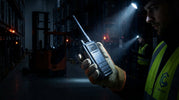
How Two-Way Radios Support Communication During Power Outages and Emergencies
, by Jesus Moraga, 6 min reading time
, by Jesus Moraga, 6 min reading time
Power failures introduce several safety risks, and these risks are exacerbated when telecommunications are vulnerable to power outages. Whether you’re a business coordinating your team or a household trying to stay connected, two-way radios are one of the most dependable gadgets available during crises.
Discover how they uphold reliable communication during power outages and emergencies.

Telecommunication infrastructure has endless potential points of failure. When you use mobile or internet services, communication data is sent to the nearest base station and travels through a series of routers, switches, and other nodes that all must be operational for the signal to reach its intended target.
Cell towers typically have backup batteries or generators to maintain cell service during outages, but this backup power typically only lasts for a few hours, especially during natural disasters like hurricanes. During emergencies, traffic also increases because everyone is trying to communicate. Because cell towers cannot process the spike in activity, the congestion causes dropped calls and unsent messages.
Two-way radios are devices that can transmit and receive radio waves for voice communication. These devices are commonly known as “walkie-talkies,” which refers to unlicensed radio devices. They can be used between two people or as part of a complex network.
Two-way radios operate with Push-to-Talk (PTT), where users transmit audio instantly to other users by pressing and holding a button, then releasing it to listen. These radios convert audio to radio waves and then transmit them through the air. Those radio waves are received by other radios, which convert the waves back to audio. Because they don’t rely on cellular towers or Wi-Fi, two-way radios are especially reliable when the power grid fails.
Two-way radios must be tuned to the same frequency to communicate with each other. These devices use either Very High Frequency (VHF) or Ultra-High Frequency (UHF). VHF is the range between 30MHz and 300 MHz, while UHF is the range between 300 MHz and 3 GHz. Some frequencies are restricted and require a license to use.
Two-way radios offer unique benefits during emergencies.
Two-way radios are highly convenient in everyday operations, but their benefits are especially prominent in emergencies.
Simplex refers to direct radio-to-radio communication. The transmission and reception of audio occur on the same frequency and require a short-to-medium range. This type of communication is best for close-proximity parties.
Repeater communication allows communication across a greater range. One user transmits a message on the repeater’s input frequency (uplink), and then the repeater rebroadcasts the message on an output frequency (downlink) at an amplified level, allowing the receiver to hear the original message loud and clear. Because repeaters rely on power grids, they can shut down during outages.
While even the most basic two-way radios will be useful in emergencies, some features should be heavily considered.
Employing the following practices ensures effective communication during emergencies.
Preparation is essential for effective two-way radio use. Businesses and households must know how many radios are needed, and preset frequencies for quick and easy channel-flipping. Train every group member on basic operation and protocol, and ensure they are equipped with backup batteries to maintain consistent communication.
Yes, walkie-talkies use batteries to operate and do not require any external power infrastructure. As long as their batteries are charged, they will work.
Two-way radios are among the most useful communication devices for a power outage since they don't rely on cell towers.
Two-way radios are often better than cell phones during emergencies. Radios do not rely on a cellular network for operation, meaning they will work just fine if cell towers become congested or go offline.
The range of a radio depends on the radio type and the terrain. VHF excels in open spaces, while UHF is more effective in indoor environments.
Two-way radios are one of the most dependable devices during emergencies. They don’t require a cellular network or internet connection, and operate on battery power, meaning they’re fully functional if grid infrastructure fails.
By understanding how they work and choosing the appropriate models, your team can stay in touch when it matters most. Find the perfect communication gear with Atlantic Radio Corp.


